
Tool · Self-inquiry
The Clarity Sequence
A recursive inquiry through five dimensions of human experience — designed to move from entanglement to clarity, and from clarity toward the awareness in which experience takes place.
The premise
The Clarity Sequence is a practical inquiry for moments when something feels alive, charged, unresolved or unwanted.
You may be anxious, angry, confused, overwhelmed, defensive, caught in indecision, repeating a familiar pattern, struggling with another person, trying to control an uncertain situation, sensing that something in your life no longer fits, or simply aware that something wants to be examined.
Most of us immediately respond to these experiences by trying to change them.
How do I fix this?
What should I do?
How do I make this feeling go away?
The Clarity Sequence begins somewhere else.
What is actually happening here?
Rather than treating an unwanted state as one solid problem, the sequence explores it through five different dimensions of experience:
- PathosFeeling / Experience
- EthosBeing / Identity
- LogosThought / Meaning
- KairosTime / Context
- TelosDirection / Purpose
These are not five personality types. They are not five developmental levels. They are five dimensions that can be present simultaneously in almost any human experience.
The sequence simply moves through them deliberately, one at a time.
And then, after the experience has been explored and gradually emptied, the inquiry changes direction completely:
Who or what is aware of all of this?
That final question does not introduce a sixth dimension.
Awareness is the space in which all five dimensions appear.
The five dimensions, and the field they appear in
 PathosFeelingThe Feeler
 EthosBeingThe Character
 LogosMeaningThe Interpreter
 KairosTimeThe Keeper of the Threshold
 TelosPurposeThe Archer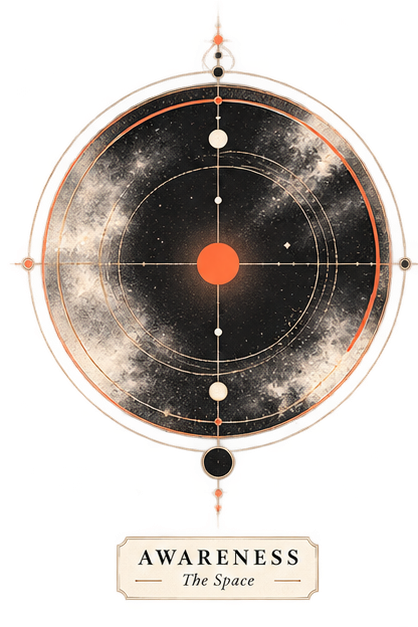
Awareness
The Space
Not a sixth dimension. The open field in which the other five appear.
Why these five Greek words?
The Clarity Sequence is a contemporary synthesis. The five Greek concepts were not historically presented as one unified psychological framework.
Three of them — Ethos, Pathos and Logos — are particularly associated with Aristotle's work on rhetoric. The other two — Kairos and Telos — belong more broadly to Greek philosophy and thought.
Together, however, they point toward five remarkably fundamental dimensions of human experience.
Lineage
Aristotle — Ethos, Pathos and Logos
Aristotle was a Greek philosopher who lived from 384 to 322 BCE. He studied under Plato, later taught Alexander the Great, and wrote across an extraordinary range of subjects including philosophy, logic, ethics, politics, biology, psychology, metaphysics, poetry and rhetoric.
In his work on rhetoric, Aristotle explored how human beings persuade one another. He identified three broad modes of persuasion:
- Ethos
- The character, credibility or disposition of the speaker. Who is speaking? Why should this person be trusted?
- Pathos
- The emotional experience of the audience. What is being felt? How is the person emotionally moved?
- Logos
- The reasoning, argument, account or intelligible structure of what is being communicated. What makes sense? What explanation or argument is being presented?
Aristotle was describing communication. The Clarity Sequence turns those same dimensions inward.
Instead of asking: How am I persuading another person?
we ask: What is happening within my own experience?
What am I feeling?
Who am I being?
What meaning am I creating?
This gives us three major dimensions of being human: Feeling. Being. Meaning.
But human experience also unfolds through time and direction. That is where Kairos and Telos enter.
Kairos
The nature of the moment
The Greeks distinguished between different qualities of time.
Chronos refers broadly to sequential, measurable time: minutes, hours, years, one event following another.
Kairos points toward something different: the right moment, the appropriate moment, the particular quality of now.
Kairos asks: What kind of moment is this?
That matters because we frequently suffer by treating today's situation through yesterday's assumptions.
A strategy that was once intelligent may now be restrictive. An identity that once helped us survive may now be unnecessary. A relationship may be changing. A role may have completed itself. An old way of leading may have worked perfectly at one stage and become limiting at another.
Kairos introduces context, season, timing and reality now.
Sometimes the deeper truth is not “What is wrong with me?” but simply: “The situation has changed.”
Telos
Direction and fulfilment
Telos can mean an end, aim, completion, fulfilment or purpose.
It became especially important in Aristotle's philosophy because he often understood things partly through what they tend toward.
Telos therefore points beyond immediate preference. It asks:
What is this in service of?
Not merely: What do I want?
But: What actually matters here? What is trying to emerge? What direction is appropriate once I see the situation clearly?
Telos returns us to movement and action — but only after experience has been examined.
The five dimensions of experience
Pathos
what is experienced, felt or undergone
Feeling / Experience
What am I experiencing?
Ethos
character, disposition, way of being
Being / Identity
Who am I being?
Logos
word, reason, account, meaning, order
Thought / Meaning
What am I believing?
Kairos
the right or appropriate moment
Time / Context
What is true now?
Telos
end, fulfilment, aim, purpose
Direction / Purpose
What matters now?
Feeling → Being → Meaning → Time → Purpose
The five dimensions describe the terrain. The Clarity Sequence is the process for moving through that terrain.
Awareness
Awareness is not a sixth dimension alongside the other five. It is different in kind.
Awareness is the space in which all five dimensions appear.
Feeling appears in awareness.
Identity appears in awareness.
Thought appears in awareness.
Our experience of past, present and future appears in awareness.
Purpose, intention and direction appear in awareness.
The final inquiry therefore does not ask us to examine another object. It turns attention toward the apparent knower:
Who or what is aware of all of this?
The question deliberately remains open. It has a natural resonance with the self-inquiry associated with Ramana Maharshi: Who am I?
The question is not designed to produce a conceptual answer. If the mind says “I am awareness,” that statement itself is another thought appearing.
The inquiry is experiential.
The sequence
What is alive in you right now?
Not: What problem do you want to solve?
Not: What outcome do you want?
Simply: What is alive?
What are you noticing in thought, emotion, body and story?
Pathos
Feeling / Experience
What are you experiencing?
- What are you feeling?
- What is happening in the body?
- What sensations are present?
- What thoughts are appearing?
- What are you resisting?
- What do you want to stop?
- What do you want to happen instead?
- What feels particularly alive?
Then: What else? What else? Anything else?
Ethos
Being / Identity
Who are you being in this?
- Who have you become in this situation?
- What role are you inhabiting?
- Who do you need to be?
- What image of yourself feels threatened?
- What identity feels responsible for solving this?
Examples: the responsible one, the rejected one, the expert, the achiever, the victim, the rescuer, the good person, the strong one, the one who must know, the one who cannot fail, the one who must stay in control.
Then: What else?
Logos
Thought / Meaning
What are you believing?
- What are you making this mean?
- What are you assuming?
- What must you believe for this reaction to make sense?
- What are you treating as fact that may actually be interpretation?
- What are you predicting will happen?
- What does this situation mean about you, the other person, or the future?
Then: What else?
Kairos
Time / Context
What is true now?
- What has changed?
- What kind of moment is this?
- What is different now?
- What has ended?
- What may be beginning?
- Is this actually a problem, or is it uncertainty, transition, grief, change, a polarity, a developmental edge, an ending, or something that cannot yet be known?
- Are you responding to what is happening now or to what once happened?
- Are you using an old solution in a new reality?
- What does this moment require?
Then: What else?
Telos
Direction / Purpose
What matters now?
- What is this in service of?
- What do you actually care about?
- What would you choose if you didn't need to defend the identity you discovered earlier?
- What would integrity look like?
- What might life be asking of you here?
- What is trying to emerge?
- What is the cleanest next movement?
Then: What else?
Emptying out
The repeated question “What else?” is a central part of the practice.
It should not feel like interrogation. It is not: “There must be something deeper.” It is: “Is there anything else here?”
The facilitator assumes neither that there is nor that there isn't.
The process allows the obvious material to empty naturally.
Often the first answer is familiar or social, the next more personal, and later answers may reveal structure. Eventually there may simply be silence.
The goal is not to reach the deepest possible answer. The goal is to allow the current dimension to complete itself before moving on.
Recursion
Why repeat the sequence three times?
The Clarity Sequence is recursive.
After completing all five dimensions once, do not analyze what happened. Simply ask:
And now, what is alive in you?
The answer may have changed.
Round One — The Presenting Experience
Often contains story, blame, explanation, urgency, emotion and justification.
Round Two — The Underlying Structure
May reveal subtler feelings, deeper identity, hidden beliefs, contradictions, vulnerability and changing context.
Round Three — What Remains?
The content may begin to thin. A paragraph becomes a sentence. A sentence becomes a feeling. A feeling becomes a sensation. A sensation may simply be present.
Do not force this. Whatever is present becomes the next starting point.
The final inquiry
Only after the third round does the process change direction.
Pause.
Then ask:
Who or what is aware of all of this?
Then stop.
No “What else?”
No follow-up.
No explanation.
No interpretation.
No “What did you learn?”
No attempt to make anything happen.
Just silence.
Discipline
Why ask the awareness question only once?
The awareness question is intentionally reserved until the end.
If it were asked after every round, it could become an escape route. Someone might prematurely use the concept of awareness to bypass fear, anger or vulnerability.
The first five dimensions allow the human material to be fully met. The repeated rounds allow it to empty. Only then does the final question turn attention away from the contents of awareness and toward awareness itself.
“The five dimensions empty the room. The final question notices the room.”
Spaciousness and timelessness
The sequence does not manufacture peace.
But something can happen when the machinery of experience becomes visible.
There may be less interpretation, defense, identity maintenance, projection and movement into an imagined future.
There can be a temporary absence of: “I need this to change before I can be okay.”
That can feel spacious.
And it can feel timeless.
Not because chronological time has stopped, but because psychological time has quietened:
I was this.
I should be that.
I need to become something else.
For a moment there may simply be this — and awareness of this.
Sometimes this is experienced as peace.
“Three rounds of sincere inquiry can sometimes reveal the quiet that was already underneath the problem.”
Practice
The partner practice
The simplest form is a two-person exercise. One person is the inquirer. The other is the facilitator.
The facilitator does not coach, diagnose, interpret, advise, reframe or rescue.
Their role is simply:
Ask · Listen · Leave space
- WHAT IS ALIVE?
- PATHOS — What am I experiencing? — What else?
- ETHOS — Who am I being? — What else?
- LOGOS — What am I believing? — What else?
- KAIROS — What is true now? — What else?
- TELOS — What matters now? — What else?
- WHAT IS ALIVE NOW?
- ↻ Repeat three times
- Who or what is aware of all of this?
- Silence
When to use it
Use the sequence when:
- you feel emotionally activated
- you are angry with someone
- you are anxious about the future
- you cannot make a decision
- you feel rejected or misunderstood
- you notice yourself becoming defensive
- you are trying to control an uncertain situation
- you feel stuck in a recurring pattern
- you are overwhelmed
- you sense that an old strategy no longer works
- you are navigating a transition
- you cannot distinguish reality from the story you are telling about reality
- you simply notice that something feels particularly alive
It can also be used when nothing is obviously wrong, beginning simply with: “What is alive in me today?”
What it is not
It is not therapy.
It is not a mental-health diagnosis.
It is not a personality system.
It is not a developmental ranking.
It is not positive thinking.
It is not belief replacement.
It is not emotional suppression.
It is not coaching toward a predetermined outcome.
It is not a method for producing enlightenment.
It is not a promise that three rounds will create peace.
Its discipline is simpler:
See what is here.
See what else is here.
Notice the space in which all of it is occurring.
The intended outcome
Clarity
Primary outcome: clarity.
Something originally experienced as one problem becomes differentiated into:
- Experience
- Identity
- Meaning
- Context
- Direction
That differentiation can change the relationship to the situation.
Reaction → Observation → Differentiation → Recognition → Clarity → Spaciousness
And potentially: Silence. Peace.
These are possible experiences, not promised outcomes.
The architecture
The five dimensions
Pathos — Feeling
Ethos — Being
Logos — Meaning
Kairos — Time
Telos — Purpose
The Clarity Sequence
Move through all five dimensions.
Within each: What else?
At the end: What is alive now?
Repeat three times.
Awareness
Awareness is the space in which the five dimensions appear.
After the final round: Who or what is aware of all of this?
Then silence.
Definition
“The Clarity Sequence is a recursive inquiry through five dimensions of human experience — feeling, identity, meaning, context and purpose — designed to help us see clearly what is happening rather than remain unconsciously inside it. After three rounds of inquiry and emptying, a final question turns attention toward awareness itself: Who or what is aware of all of this?”
From reaction to recognition. From recognition to space. From space back into life.