
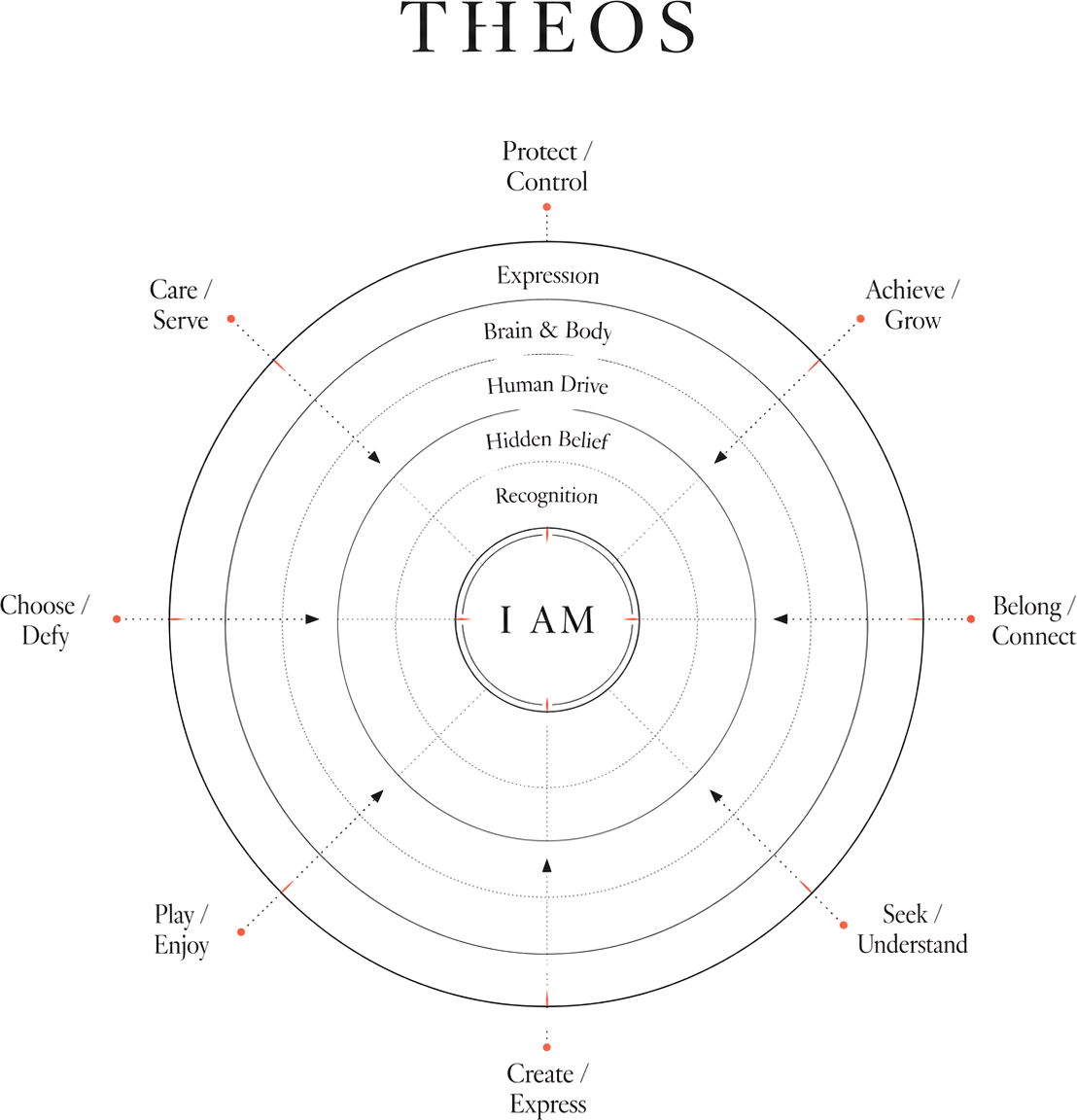
THEOS: concentric layers from Expression through Brain & Body, Human Drive, Hidden Belief and Recognition to a central I AM

Tools · THEOS™

The Human Evolution Operating System

A practical map for understanding what drives human behaviour — and tracing any recurring pattern inward, from what we do to what we believe, and ultimately to what we are.

  1. Expression
  2. Brain & Body
  3. Human Drive
  4. Hidden Belief
  5. Recognition

The premise

Most of us experience life from the outside in.

Something happens. We react. We control, strive, please, seek, create, escape, resist or help. We may become very good at managing our behaviour, but rarely stop to examine the deeper structure producing it.

THEOS reverses that process.

It begins with a simple observation: every behaviour is an expression of something deeper. Rather than judging or correcting the behaviour, THEOS follows it inward.

The intention is to see clearly enough that the beliefs and identifications driving behaviour can begin to loosen — and, sometimes, collapse altogether.

The map

From expression to recognition.

  1. 01ExpressionWhat am I doing?
  2. 02Brain & BodyWhat is happening in the organism?
  3. 03Human DriveWhat am I actually seeking?
  4. 04Hidden BeliefWhat must I believe for this to feel necessary?
  5. 05RecognitionWhat remains when the belief is seen?

At the centre

I AM

Not another strategy. Not another identity. Not another thing to achieve. The simple fact of being — before the next achievement, explanation, relationship, experience or improvement is added.

The five layers

Read from the outside inward.

01

Expression

What am I doing?

THEOS begins with lived experience. What is actually happening? Perhaps you are trying to control something, working harder, looking for approval, searching for an answer, trying to express yourself, seeking stimulation, resisting limitation, rescuing someone.

Instead of asking “What is wrong with me?” we begin with “What am I noticing myself doing?” The behaviour becomes information.

02

Brain & Body

What is happening in the organism?

Human behaviour is embodied. Threat, attachment, reward, curiosity, autonomy, pleasure and caregiving all have biological and nervous-system correlates.

The purpose is not to reduce human experience to neuroscience. It is to recognize that the organism is responding intelligently according to what it perceives it needs. This can bring considerable relief. Instead of judging ourselves for reacting, we can become curious about what the body and brain are attempting to protect, obtain or preserve.

03

Human Drive

What am I actually seeking?

Beneath apparently different behaviours sit a small number of fundamental human drives. THEOS currently maps eight.

These drives are not problems. They are part of being human. The important shift is recognizing that the visible behaviour is often only a strategy for obtaining something deeper. Control may be an attempt to feel safe. Achievement may be an attempt to feel worthy. Approval may be an attempt to feel loved. Knowing may be an attempt to feel secure.

Once the deeper drive becomes visible, the behaviour begins to make more sense.

04

Hidden Belief

What must I believe for this to feel necessary?

This is where THEOS becomes more than a behavioural or motivational framework. Beneath the drive often sits an assumption — I am not safe unless I remain in control; I am not enough unless I achieve more; I need your acceptance in order to feel whole; I need to understand before I can relax.

These beliefs are rarely experienced as beliefs. They feel like reality. And that is precisely why they have power.

THEOS does not simply replace an uncomfortable belief with a more positive one. Instead, it asks: is this actually true?

05

Recognition

What remains when the belief is seen?

At the deepest layer, the inquiry changes. The question is no longer “How do I get what I need?” It becomes “Does the fulfilment of this need determine what I am?”

The organism may still want safety, achievement, intimacy, creativity, pleasure, autonomy and contribution. THEOS does not ask us to eliminate our humanity. It asks us to distinguish between a need appearing in experience and an identity built around needing that need to be fulfilled. That distinction creates freedom.

The eight human pathways

A small number of drives, and the assumptions beneath them.

These drives are not problems. They are part of being human. The visible behaviour is often only a strategy for obtaining something deeper.

Protect / ControlSafetyI need control in order to be safe.
Achieve / GrowWorthI need to become more in order to be enough.
Belong / ConnectLoveI need acceptance in order to be whole.
Seek / UnderstandTruthI need certainty in order to be secure.
Create / ExpressExpressionI need to express or contribute something in order to be complete.
Play / EnjoyJoyI need another experience in order to feel alive.
Choose / DefyFreedomMy freedom depends upon external circumstances.
Care / ServeUnityI need to help, rescue or contribute in order to be good or whole.

From insight to experience

THEOS is designed to be used, not simply understood.

Each pathway can include reflection questions that expose the hidden assumption, and short experiential exercises that allow someone to test the belief directly.

  • Someone who believes they must control in order to feel safe might intentionally leave a low-stakes uncertainty unresolved for two minutes and observe what actually happens.
  • Someone whose identity is organized around achievement might deliberately accomplish nothing for several minutes and examine whether their fundamental worth has disappeared.
  • Someone who seeks certainty might rest consciously in “I don’t know.”
  • Someone who derives identity from helping might allow another person to solve a small problem without stepping in.

The aim is not behavioural discipline. It is experiential discovery. The person temporarily stops obeying the operating system and observes: what actually happens when the strategy isn’t followed?

This can create a gap between impulse, behaviour and identity. Inside that gap, a belief that previously felt unquestionable can begin to lose its authority.

Practical value

A repeatable way to work with everyday experience.

A difficult conversation. A need to prove yourself. Fear of rejection. The relentless search for answers. The compulsion to stay busy. The desire to escape. Conflict about freedom. The inability to stop helping.

Trace inward

  1. 01What am I doing?
  2. 02What is happening in my body?
  3. 03What am I trying to obtain or protect?
  4. 04What must I believe for that to feel necessary?
  5. 05What remains if that belief is not assumed?

Over time, the operating system itself becomes visible. And what becomes visible is no longer entirely automatic.

The deeper purpose

THEOS is not ultimately about becoming a better human being.

It is about understanding the human being deeply enough that we no longer confuse every impulse, need, belief and identity with what we fundamentally are.

The organism has needs. The personality has preferences. The mind creates meaning. The nervous system reacts. All of that can remain. But it can increasingly be seen. And what is seen no longer has to run the whole system.

THEOS — The Human Evolution Operating System

A map from expression to recognition.

See what drives you.
Discover what you believe.
Recognize what remains.