Conversation
Begins with lived experience rather than a predetermined agenda. The point is not to extract information so someone else can diagnose the problem, but to create openness and attention so the underlying structure can reveal itself.

Tools · The method
How the work is actually done.
CORE™ is not a diagnostic. It is the process used to work with whatever a diagnostic brings into view, and it circles rather than ends.
It is not coaching, and it is not an attempt to fix, correct, optimise or improve the person. Its purpose is to create and hold the conditions in which clearer seeing can occur. Through careful attention, listening and inquiry, a conversation can reveal what advice usually obscures.
The premise is simple. What a person sees for themselves tends to hold, while what is handed to them from outside tends to fade. CORE™ therefore assumes that discernment and a workable sense of direction are already present in the person, however obscured, and that the task of a conversation is to make that available rather than to replace it with someone else's conclusion.
Whether this happens in Recover the Signal, The Council, another shared setting or one to one, the role is not to supply the answer or manufacture the breakthrough. The quality of attention and dialogue is what allows recognition, insight or a genuine shift in perspective to emerge from the person, or from the room itself — which is why the work is to stay with the inquiry long enough for that to happen.
The premise
CORE™ is not a process for delivering advice. It creates the conditions in which insight can emerge from the conversation itself — and from the field of joint intelligence between two people, which is more capable than either of them alone.
The facilitator contributes attention, questions, pattern recognition and reflection. The other person contributes lived experience, perception and discernment. Neither is treated as the sole source of truth, and the work belongs to what happens between them.
The aim is transformative rather than instructive. Advice remains external, held as someone else's conclusion. A recognition seen directly for oneself becomes one's own perception, and tends to stay.
CORE does not tell you what to see. It creates the conditions in which you can see for yourself.
The cycle
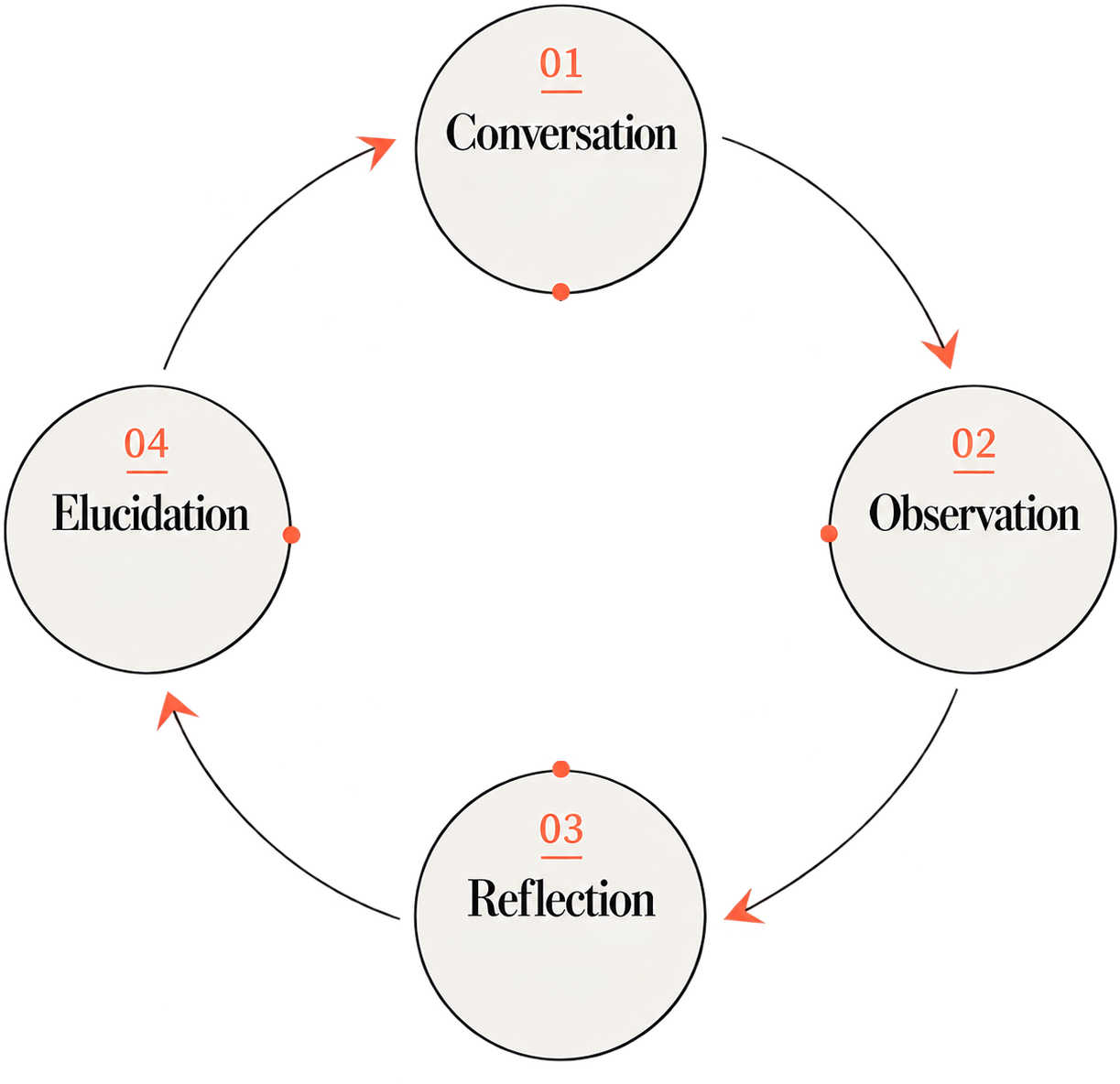
CONVERSATION → OBSERVATION → REFLECTION → ELUCIDATION →
Elucidation does not end the process — what becomes clear opens the next conversation.
Begins with lived experience rather than a predetermined agenda. The point is not to extract information so someone else can diagnose the problem, but to create openness and attention so the underlying structure can reveal itself.
Patterns appear in what is said and in how it is described, defended, avoided, repeated or assumed. Observations are held lightly rather than imposed.
What is noticed is reflected back through a question, distinction or observation, so the person can examine their experience from another position. Something that felt like reality may become visible as a pattern or an assumption.
What was implicit becomes clear enough to name. A hidden assumption, a recurring pattern, a decision or a belief may become visible — but the recognition belongs to the person who sees it, rather than being supplied from outside.
Joint intelligence
A conversation held with enough attention becomes its own instrument. What appears is rarely traceable to one person — it arises in the space between them, in the field the two of them are holding open.
This is why the method does not rely on expertise being transferred. Expertise can only deliver a conclusion. Attention can reveal a structure, and a structure once seen changes what a person is able to do next without being told.
expert → advice → action
attention → recognition → clarity → natural response
The second sequence is slower to begin and far more durable. It is also recursive: each clarity opens a further inquiry rather than closing the matter.
The method lives inside The Inquiry — in the shared rooms, and in private work.
The most direct way to see it in use is the next Conversation: a free live session every two weeks where one idea or exercise is worked through in the room.